Got an E36 or an E46? You can now give it the new car treatment with main dealer servicing
Do you own a BMW 3 Series of the E46 generation, on sale from 1998 to 2006? You already know it's a classic, but now it's official, following BMW's UK appointment of four Classic partners, existing main dealerships equipped and approved to service, repair and restore your old E46 and those generations that came before it – not only 3 Series but all BMW models that ceased production as recently as 2010.
You might think all BMW dealers that have held the franchise long enough must have experience with these and many of the other classic models covered by the programme (if not all of them, since it covers cars built as far back as 1960).
However, over time workshop staff move on or retire and technology is always advancing – meaning that, bit by bit, experience with old mechanicals, electrical systems, paint finishes and body construction is slowly being lost. The BMW Classic partners programme aims to recover and reapply this knowledge.Â
To be accepted as a partner, a dealer must show specialist expertise in classic BMW vehicles, including heritage knowledge, have access to original BMW Classic parts and exercise factory-approved standards of care.
BMW says the four UK dealerships it has chosen – Halliwell Jones Wilmslow, Sytner Stevenage, Group 1 Hailsham and Dick Lovett Bristol – will ensure that British customers with classic BMW models can access dedicated support locally while benefiting from the assurance and quality associated with the global BMW Classic programme.
You read that right: already there are plenty of partners across the continent, a couple in the Middle East, a handful in the Far East and one in Australia. Supporting them behind the scenes, and now also the UK's four newly appointed partners, is BMW Group Classic.
With its help, dealers can source genuine spare parts and, where they are no longer available, approved reproduction parts. It also issues vehicle 'birth certificates', giving details of a car's precise build date and original specification. It has a maintenance and restoration workshop based within the main plant network in Munich, albeit primarily for older, historic vehicles.Â
To find out what being a BMW Classic partner means in reality and how the programme can benefit the owner of a qualifying model, we met some of the people tasked with delivering the programme at Group 1 Hailsham in East Sussex.Â
There's a good reason we chose this dealership: over the past five years, long-serving staff technician Adam Hook and his young son have, using the dealership's workshop and bodyshop, restored an E36 BMW 328i auto, originally sold new by the dealer in 1996 and owned by Hook since 2009.
The process has helped educate not only Hook but also everyone else who has come into contact with the car, which is in the showroom under a black cover, awaiting its unveiling… "Restoring this car with my son turned machinery and metal into something far more meaningful: shared time, pride and lasting memories," says Hook.
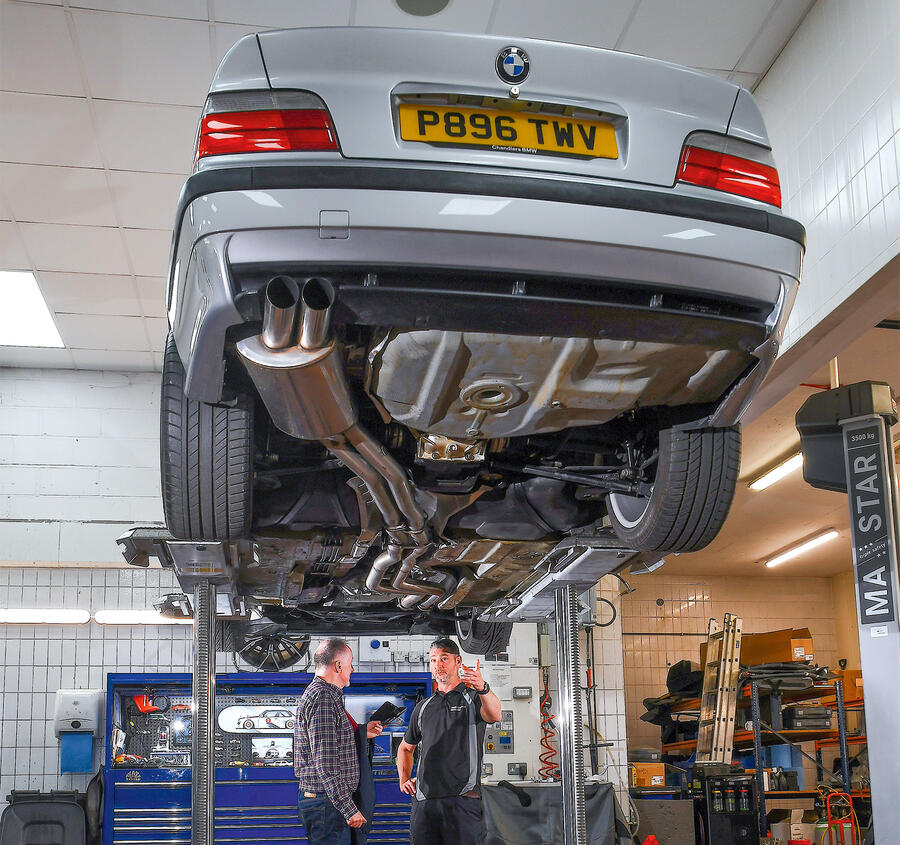
However, as the cover is removed, it's not a 328i that emerges but something even more desirable and, as I'm about to discover, so meticulously restored that it defies belief. "As a 16-year-old, the car of my dreams was an E36 M3 Evo," says Hook. "I couldn't afford one, so years later I built my own."
But with a difference: rather than the S50-series 3.2-litre engine that the Evo used, Hook replaced the 328i's engine with an Alpina B3 3.2 unit, mating it to a six-speed manual gearbox. Elsewhere, he upgraded the suspension with fully adjustable coilovers and fitted a new back axle and control arms and an M3 anti-roll bar, full M3 exhaust and M3 suspension arms. Inside it, he installed a genuine Evo interior.Â
And then Hook became a little more obsessive. He painted rather than powder-coated the running gear, his argument being that if any part is chipped, it can easily be touched up. He coated the chassis in Waxoyl not using today's clear formulation but rather the period-correct amber Waxoyl of old. Finally, he had the body resprayed by the bodyshop staff, who made sure they applied the period-correct orange peel finish.Â
The car looks and sound fabulous and is clearly a source of pride not only within the workshop – which has two master technicians, one of whom is currently in Munich, learning all about carburetors, points and condensers – but also the wider dealership.Â
Steve Packer, aftersales manager, is excited at the prospect of the Classic partner programme helping customers breathe fresh life into old BMWs like Hook's. "Thanks to the programme, we now have full access to BMW's support team in Munich and the company's classic parts inventory and approved suppliers," he says.Â
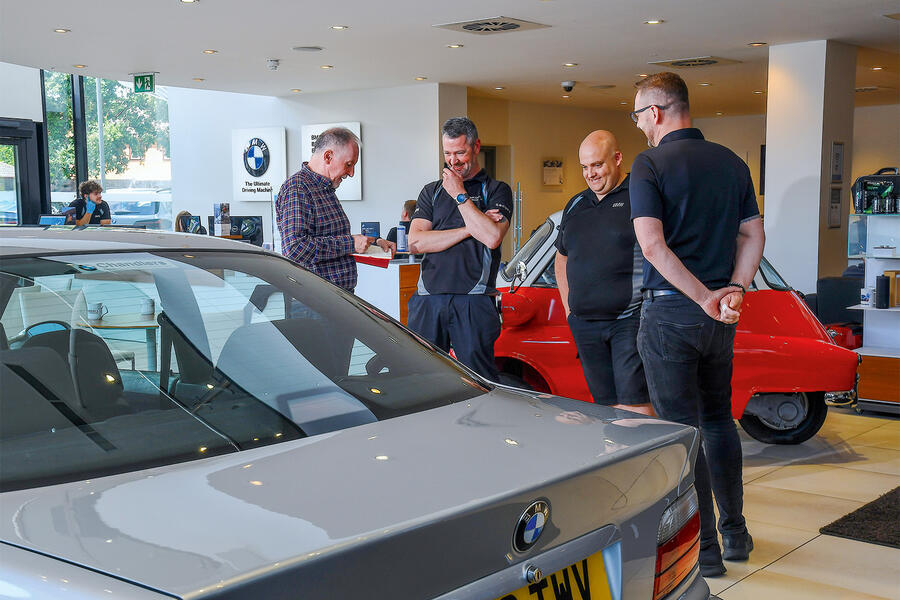
Meanwhile, behind the scenes, the workshop has been busy acquiring the necessary tooling and equipment, some of it from technicians who have been with the dealership for years, people who are pleased with the programme's insistence that wherever possible things should be repaired rather than replaced.Â
But a question remains: with BMWs being among the most expensive cars to repair, what can someone with an old E36 expect to pay for work under the BMW Classic partner programme? Packer won't discuss specifics. He says: "Every job is unique so it's hard to say but we already have our Value Servicing programme offering lower prices for cars more than three years old. For older classic cars, we say: 'Talk to us. We want to help.'"