
Recent Updates
08/15/2026 12:00 PM
JCB Hydromax: inside the quest to set a 406mph hydrogen record
08/15/2026 12:00 PM
National Motor Museum confusion proves we need plain speaking
08/15/2026 12:00 PM
Concours restorations? I prefer to save a banger on a budget
08/15/2026 12:00 AM
Stunning new McL 6GT is first manual McLaren since the F1
08/15/2026 12:00 AM
Porsche Taycan to be discontinued by 2030, report claims
08/15/2026 12:00 AM
ZEV mandate consultation launched: review could soften electric car sales targets
08/15/2026 12:00 AM
McLaren's manual revival shows the art of stick-shifting isn't dead
08/15/2026 12:00 AM
Wild new Aston Martin Valen is a V12 brute with 838bhp
08/15/2026 12:00 AM
Spyker returns with C8 supercar – and plans to finally finish SUV
08/15/2026 12:00 AM
Slantnose Porsche 911 back as 691bhp supercar
EV, Hybrid, Hydrogen, Solar & more 21st century mobility!
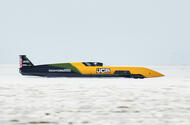 Andy Green's run to a hydrogen land speed record looked easy – but things weren't nearly that simple
The Bonneville Salt Flats were named to recognise explorer Benjamin Bonneville. But to the special, wonderful breed of individuals drawn to this quiet corner of Utah to drive extreme vehicles as fast as they possibly can in a straight line, it’s simply known as The Salt.
The definite article is used because The Salt isn’t simply the remnants of a long-dried up lake. It’s vast, otherworldly and barren yet simulteneously evocative and steeped in history. Hot, dry, exposed and, yes, very salty, it’s a hostile, challenging environment to spend any time in. And that’s exactly why it’s irresistably alluring to speed record chasers.
The expanse of Bonneville makes it the ultimate blank canvas: with an ambitious dream, you can write your own story here. The possiblities are endess, although it helps if that dream involves going very quickly in a straight line. And 18 months ago, JCB chairman Lord Bamford dreamt up a story.
Strictly, this was a sequel: 20 years ago, the JCB Dieselmax came to Bonneville and set a new 350mph land speed record for diesel-powered cars. This time, Bamford wanted to showcase his firm’s burgeoning hydrogen combustion technology.
He summoned Ryan Ballard, JCB’s engineering director, and Lee Harper, its chief engineer, and asked them to take two of the firm’s hydrogen-combustion digger engines, stick them in a slipstreamer and smash both the hydrogen speed record and Dieselmax’s time.
Ballard walked away from that meeting thinking this was a dream too far for Bamford, that it simply coudn’t be done. But then he and Harper thought about it, crunched some numbers and realised it could work, “which meant we actually had to go and do itâ€.
Eighteen months later, soon after Andy Green had powered the JCB Hydromax across The Salt at an average speed of 406.320mph, Ballard sits down in front of me, looking tired, relieved and very satisifed. Bamford’s dream has been realised.Â
The preparation
It takes less than an hour to set a land speed record – and only 18 seconds or so of that really matters. Under FIA rules, cars must complete two runs on a course in opposite directions; they have 60 minutes from the start of run one to passing the finish on the return.
The JCB team used a 10-mile course, leaving an extra mile of run-off in either direction.
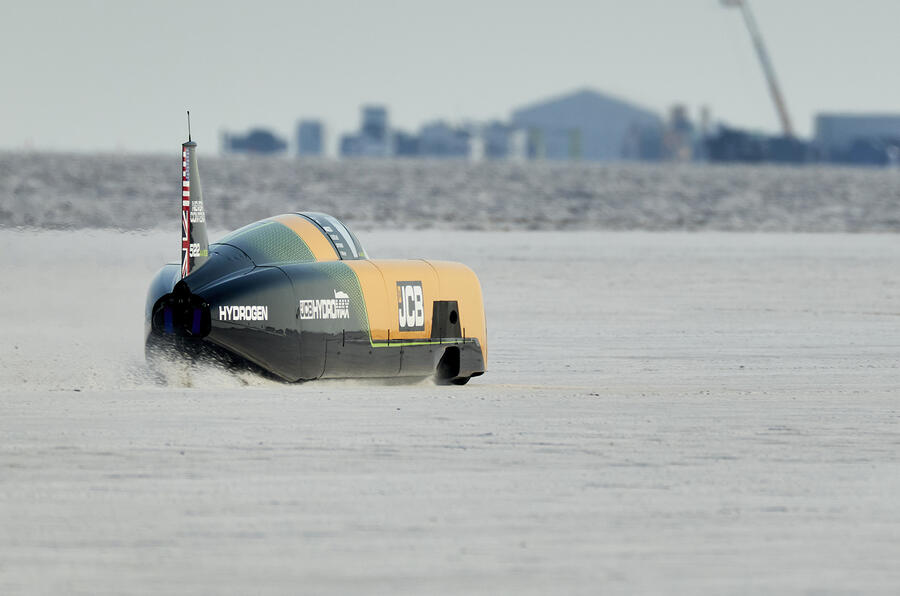
The crucial bit is the measured mile, which at 406.320mph took Hydromax less than nine seconds to cover.
“The run itself was relatively drama-free,†says Ballard. “But while it may have looked calm, there was an awful lot going on.â€Â
That has been true of the project from the start: while it was only publicly announced in May this year, Ballard and his team had been working intensively for a year or so before that.
This was a true JCB passion project: Ballard, Harper and numerous other members worked on Hydromax and its innovative powertrain alongside their day jobs, developing and refining the engineering firm’s construction machines. Several members also worked on Dieselmax, and that car provided a basic template.
Another key holdover from Dieselmax was driver Green, the holder of the outright 763mph land speed record with the Thrust SSC jet car in 1997. Now 64, Green underwent physical tests to prove he could still deliver behind the wheel; in return, JCB had to convince him about the fuel source.
“I started by saying ‘you want me to strap into a car with how much pressurised hydrogen?’†he says. “They utterly convinced me about its safety. I’d now rather be in a hydrogen car than a petrol or diesel one.â€
While much of the project was done in-house, specialist help was recruited.
Ricardo was tasked with taking JCB’s production-spec 4.8-litre hydrogen-combustion engines and turning them from a 74bhp lump used by diggers into 800bhp race units. The firm fitted special radiators, intercoolers and turbochargers, lightened them by 100kg and modified them so they could run on their side to lower Hydromax’s centre of gravity. Six engines were hand-built.
Prodrive developed the tubular steel frame chassis and multilink suspension, Xtrac provided a six-speed gearbox (each engine was attached to its own gearbox and its own axle), while Goodyear – which has pretty much cornered the market in speed record tyres – developed custom sets for the project.
Dieselmax was essentially limited by its tyres; Ballard says the new Goodyears were “stress-tested to beyond 400mph, and we were quite close to the upper limitâ€.
Aerodynamics were a focus, the design being honed to produce 10% less drag than Dieselmax. Features specifically for Bonneville include sculpted salt spray extractor channels, designed to force salt off the car’s underside, where it would otherwise get stuck and create drag.
What the team lacked before the record attempt was mileage: there was a single test at RAF Wittering, where Green barely pushed past 200mph, before travelling to Utah. The bulk of Hydromax’s testing would come in the public arena of Bonneville Speed Week.
Getitng up to speed
Speed Week is Bonneville Speedway’s crown jewel event, drawing hundreds of brave teams and thousands of spectators to The Salt.
The nearest town is Wendover, which straddles the border of Utah and Nevada. Most of the hotels are on the Nevada side of the state line and contain massive casinos; think Las Vegas with all the glamour of a truck stop.Â
The Hydromax workshop was located in a hangar on Wendover Airfield, famous for being from where Enola Gay departed the US in 1945. Thankfully, JCB was there to tell a far more positive story.
Given the effort that goes into developing a speed record challenger, it’s hard to comprehend how little running they do.
“When we arrived, we’d done the equivalent mileage of seven laps of Le Mans,†says Green. “Imagine turning up to that race with a car that had done seven laps of testing.â€
The challenge of The Salt is that, like any natural surface, it’s always changing. Much of the vast white surface is pockmarked with a crusty top layer.
Officials from the Southern California Timing Association (SCTA) repeatedly drive the course in a fleet of pick-ups dragging big metal blocks, creating a flat, smooth surface.
The thickness of the salt varies along the course, creating different grip levels. And the wide changes in heat cause massive variance in how much moisture is near the surface. You learn about the salt by driving on the salt.
Speed Week was one long learning experience: adjusting gearing and traction and power delivery and steering. The course was run in a single direction, going north towards Floating Mountain.
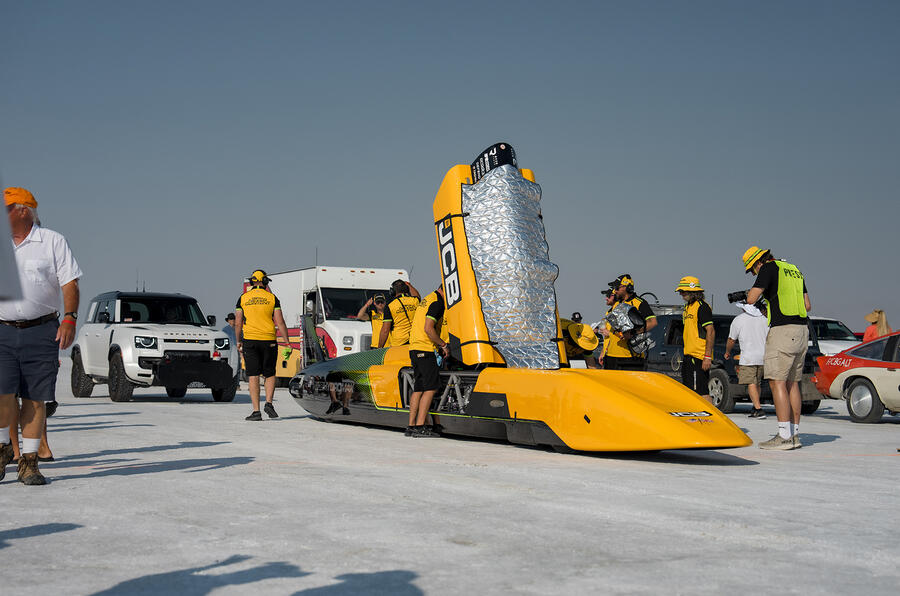
Traction off the start was an issue: because of the gearing length, Green couldn’t engage first gear until Hydromax was doing 55mph, so a Defender Octa was used to push it up to speed, but even pro driver Darren Turner struggled to find enough traction in the 4x4.
The most crucial learning experience of Speed Week: how to stop. The two determining factors in how fast a land speed record car can go: its tyres and how quickly it can brake.
For Hydromax, first Green lifts off the throttle to allow any remaining hydrogen to be purged from the car, then deploys two parachutes that slow the car before the friction brakes can be used.
Ensuring the parachute system worked as intended and refining the parachutes themselves was key. Green chose to pack them into the car himself.
By the end of the week, the Hydromax had clocked 368.347mph – a new class record.
That had been done with the same two engines used for the UK testing, tuned for around 600bhp each. Over the weekend, JCB’s engineers switched them out for two fresh engines, each producing closer to the 800bhp maximum.
Record time
With Speed Week over, by Monday JCB had The Salt to themselves. The only sign of the mass gathering on this vast landscape just days before were rows of Honey Bucket portable toilets, still awaiting collection.
This was a test day, with Green making three runs and slowly learning what difference that extra power made.
“The course had changed too,†says Ballard. “Even after a few days, the salt was completely different, so we had to make some changes to the power deployment.â€
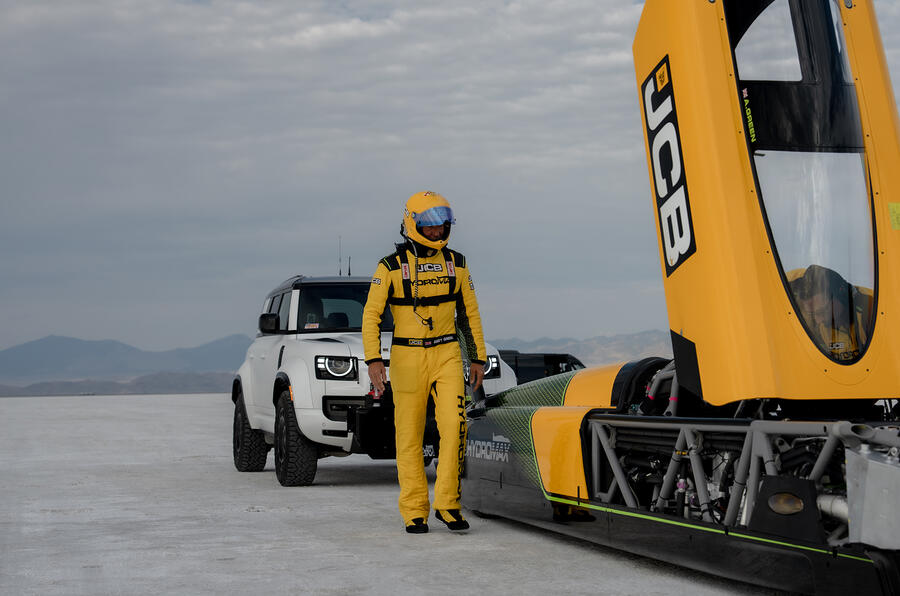
Another challenge: this was Green’s first chance to drive the course in the reverse direction, running south from Floating Mountain.
Working out how to stop the car in this direction was particularly crucial, because if he exceeded the run-off area, he would end up on Interstate 80.
That brought the total runs Hydromax had completed to just 47. Only two remained. But there was plenty to sort before them.
“We were making changes to the car into the night,†says Ballard. “Then we found the rear motor had ingested some black plastic and wrecked the turbocharger. So we had to change that, and the air cooler as well.â€
Despite that late night for the mechanics, Tuesday required an early start: the optimum time for a record run is after early moisture has burned off but before the heat rises too sharply. Thankfully, conditions on Tuesday were perfect.
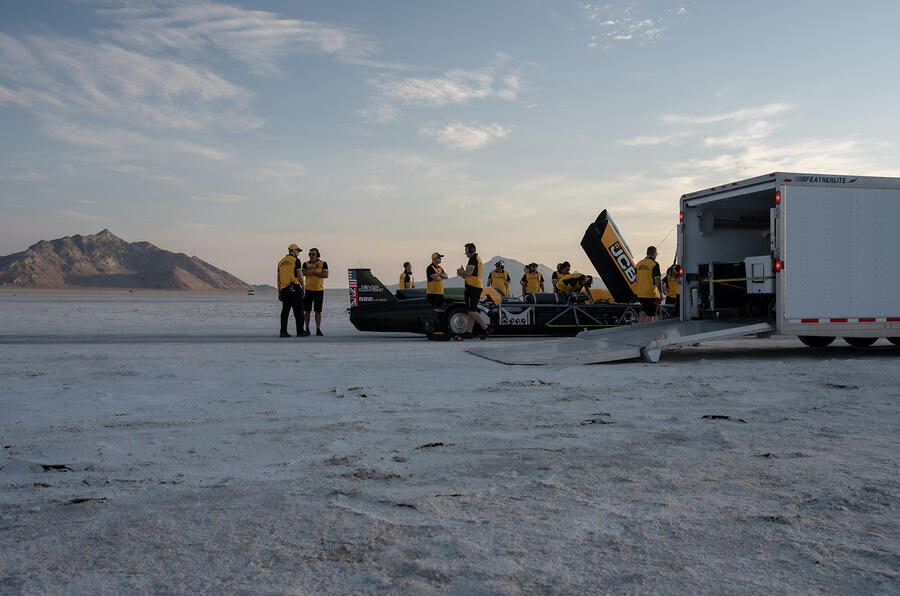
The same couldn’t be said for Hydromax. When the team unloaded the machine from its custom trailer at the start line, there was an oil leak from the rear turbo.
“We can’t really work out why, given we had changed the whole thing,†says Ballard. Still, the only option was to fit an entirely new one on the salt flats. “We said a little prayer, fired it up and it worked.â€
Entering history
Once settled, Green clambered into Hydromax while the engineers shoved in the 250kg of ice necessary to keep the car cool during its run, fired up the engines and waited for 'Octa-pushy' – with Lord Bamford in the passenger seat – to shove him up to 55mph.
From there, Green worked up through the gears until exceeding 400mph. For the first run, his goal was to go marginally faster than 400mph – a solid base to work from.Â
“We hit the first mile at 230mph,†says Green, “still accelerating through fourth and fifth. Mile five is the go/no-go for whether we’re going to make 400 – and we’re over-performing, doing 410mph going into the measured mile. It’s the fastest I’ve ever gone in this car.â€
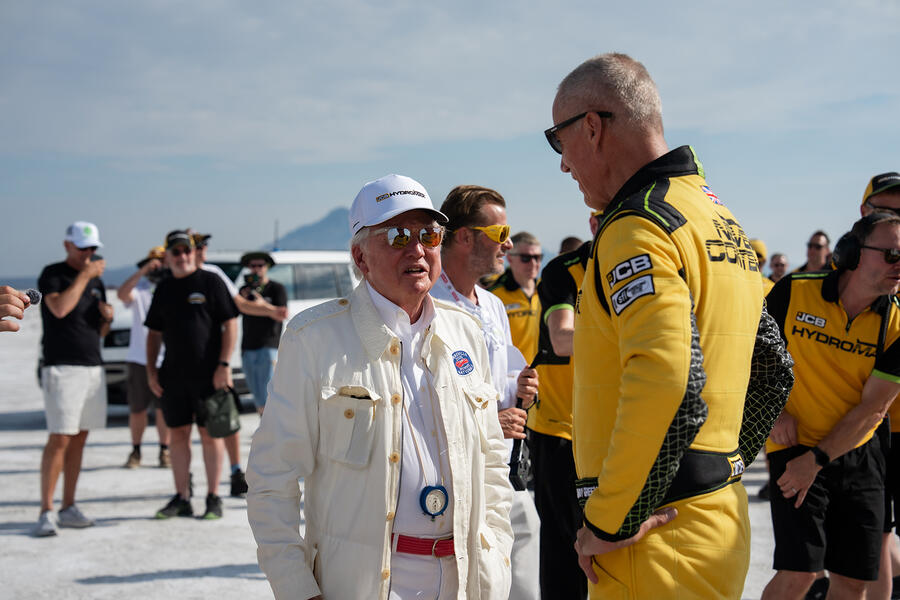
The crucial part of the course ran from mile 5.5 and, paradoxically, Green lifted and turned off the engines as he entered. This allowed the engines to purge ahead of the 3.5-mile slowdown.
“The aim is to control the speed,†Green says, “although I actually lifted off about 100 yards too early.â€
Green passed through the mile at 400.623mph, cutting it finer than anticipated. Parachutes, brake and steer off the course – as much as a car with barely any steering can – and then it’s turnaround time. Change the tyres, refill the ice, refuel and more.
“We’ve got 50 minutes, so it’s an absolute race,†says Ballard. While there was a receiving team at the far end of the course, engineers in the JCB pits are already analysing telemetry data sent over 5G.
One of Ballard’s jobs was to pull a physical memory stick with the high-fidelity data from the car and hand it to an engineer who would speed back to the pits five miles away in a Defender Octa with more data to check.
“We were a bit worried about the high temperatures,†says Ballard. “The car got so hot it burned the paint and carbon on the side and was really close to triggering an alarm that would have meant aborting the second run. So we had to make an instant decision to change the calibration for the engines over the airwaves with minutes to spare.â€
Still, the team had planned for this. “You think it’s simple, given it’s a straight line, but the team is split across 10 miles of salt flat," says Ballard. "The logistics have taken some figuring out.â€
With the turnaround complete, it was back over to Green. This time, Lord Bamford and his family were at the side of the course waiting to see Hydromax shoot past. When it flashed past with an engine whoosh that sounded more Spitfire than digger, it looked fast. Well, faster than any other run.
And it was: Green’s speed for the return leg was 412.135mph. Job done. The team’s incredible efforts across 18 months and a frantic hour of intense activity were repaid in less than 18 seconds.
The world has a new fastest-ever hydrogen car. In fact, Hydromax is the fastest zero-emission car on the planet.
Lord Bamford spoke of how the records proved that hydrogen must be part of a low-carbon future, especially for heavy machinery. His dream had been emphatically delivered on The Salt.
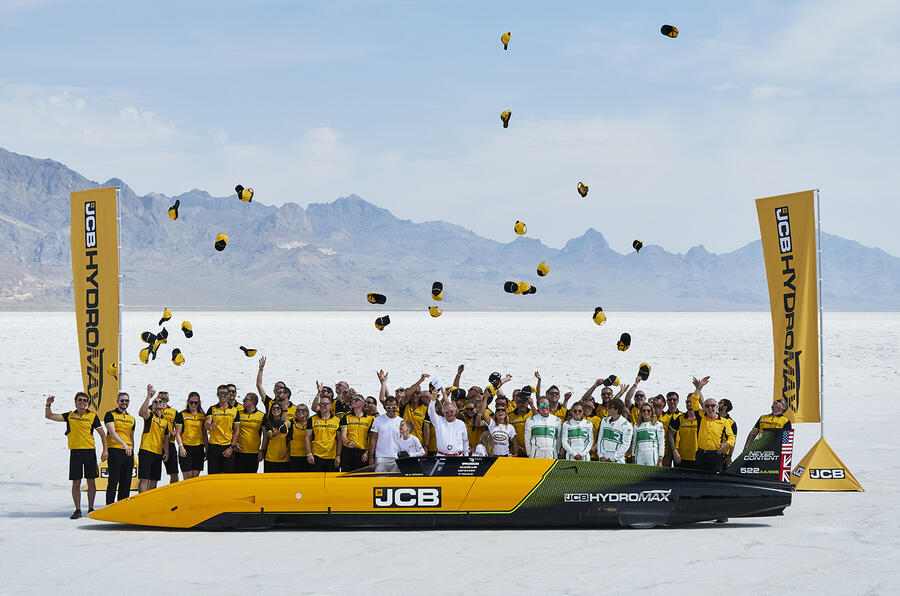
For Ballard, though, “the overwhelming emotion is ‘thank goodness we’ve done it’. There have been many times in this process I’ve sat there thinking ‘how are we going to do this?’. My wife and family are here, and they’ve pulled me through a few times.
“We took it to the edge of the performance envelope. And to think all that’s coming out the back is H2O. It’s brilliant. Absolutely brilliant.â€