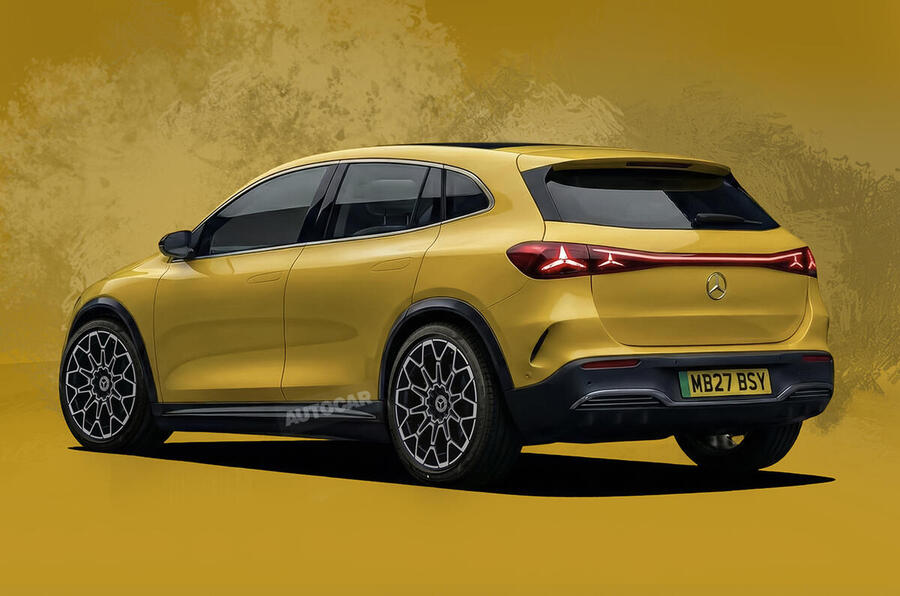
Our shortish, tallish vision of the new A-Class evokes the spirit of the original, but only because it has to
So the next next Mercedes-Benz A-Class will be taller than the current one.
Its proportions might even resemble the brilliantly packaged original of 1996. Back then, in a university essay, I predicted it would be a revolutionary car. Shows what I knew. Instead, the A-Class evolved into an ordinary hatchback, with people talking about the Mk1 a bit like they do the Audi A2: ahead of its time.
They weren't really ahead of their time, though. Had they been, by now loads of cars would be built like them. But aside from the fact that there are lots of companies that make no money selling small cars, they aren't.
One element of both their designs has, entirely coincidentally, filtered through to the mainstream: their raised H-point, or hip point: the distance of one's bum from the ground.
It's not because their intelligent, compact vehicle packaging, with upright seating positions that allow big interior space, has caught on; it's just that, first, we fell in a big way for SUVs and crossovers, which by nature have higher driving positions. Then, more latterly, we've started putting batteries underneath the cabin, which also raises the cockpit floor.
This should enable more cars to be built like the original A-Class, which had what we described as a "complex sandwich platform": a flat cabin floor above a lower floorpan, with the engine forcing its way between the two in the event of a front-on impact in an accident.
These days double floors exist in effect in lots of electric vehicles, with batteries between them. If you don't need a large motor out front, it should be possible to reduce a car's length while retaining its interior volume, A-Class-style. But we haven't seen much evidence of it; I think there's still a preconception that a short car is a cramped car and therefore should be cheap.
There are benefits to the new trend for a higher driving position. What many customers like about crossovers is that the H-point is at the 'right' level for entry and egress. When I drove my nonagenarian neighbour to the shop earlier this week I took us in my A2 rather than a BMW 3 Series coupé or Land Rover Defender, because the Audi was the best height for her. It's easier if you're loading small children, too.
But there are downsides. A tall car isn't naturally useful for minimising the frontal area, where smaller is better for efficiency. It's also less good if one of your selling points is building dynamically focused cars, when a low-slung driving position makes a car feel sporty.
BMW's latest Neue Klasse platform has so far given us the iX3, a crossover in which the seating position is high relative to the steering wheel and the ground. If you get into one from the 330Ci coupé I'm running, or even a modern 3 Series, it's a striking difference.
But while it quite suits an SUV like the iX3, this platform also sits under the i3, a 3 Series variant and surely the relative seating set-up will be similar there, too. The feet position will inevitably be higher than in a combustion-engined saloon, and so, if even the driving position remains relatively similar to that of a current 3 Series, it will naturally feel taller, and perhaps less typically BMW sporty (we'll see), than a current car.
Some BEVs aim to retain low height by having their batteries split into sections, so occupants' feet can fill the gaps between them. Smaller Stellantis BEVs, such as the Peugeot 208, do it, as does the exceptionally low-slung upcoming Jaguar Type 00, whose height is less than 1400mm.
This has its packaging disadvantages -a single big cuboid is the easiest way to squeeze in battery cells but it does mean batteries – and occupants – can both be sited low, which retains a sporty driving position, a low centre of gravity and a smaller frontal area.
But if one wants to produce a number of vehicles, of varying lengths and battery capacities, all from the same platform, it's not as convenient or affordable as having a single underfloor battery pack whose size can easily be varied depending on model.
It's what will make new BEVs feel like the original A2 and A-Class. Their futuristic feel has come, even though, in reality, they were a technological dead end.