Recent Updates
06/25/2026 12:00 PM
BMW M3 Touring poised for epic Neue Klasse comeback
06/25/2026 12:00 PM
Top 10: World’s longest road tunnels
06/25/2026 12:00 PM
Vauxhall given new freedom to adapt Opel cars for UK roads
06/25/2026 12:00 PM
Electric car vs heatwave: Can my Renault 4 cope in 34 degrees?
06/25/2026 12:00 PM
Inside JCB’s plans to smash hydrogen land speed record
06/25/2026 12:00 PM
Semi-solid vs solid state: Decoding the future of electric car batteries
06/25/2026 12:00 AM
Driven: Porsche Taycan gets gearshifts - and renewed driver appeal
06/25/2026 12:00 AM
Audi Q4 E-Tron
06/24/2026 12:00 PM
Morgan returns to coupes with stunning Midsummer hard-top
06/24/2026 12:00 PM
What if you drove an Autocar? The name that's more than a magazine
EV, Hybrid, Hydrogen, Solar & more 21st century mobility!
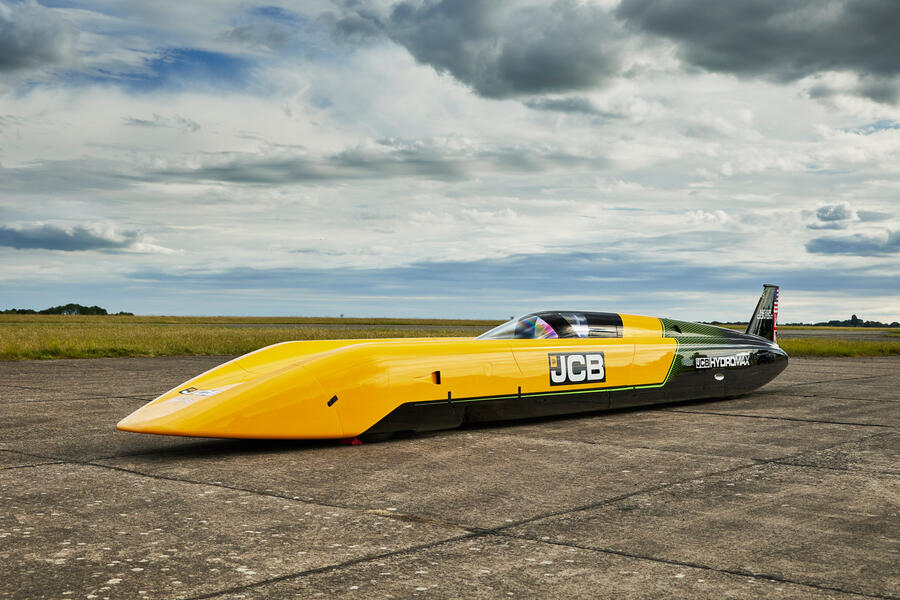
 The British engineering firm’s Hydromax challenger has topped 208mph in testing
British engineering firm JCB’s new Hydromax land speed record challenger has reached 208mph to exceed the current speed for the faster hydrogen-powered combustion car as its testing programme wraps up.
The firm is aiming to set a new hydrogen land speed record with the machine on the Bonneville Salt Flats in Utah in August, repeating its success in setting a diesel land speed record with its Dieselmax challenger in 2006.
The car has reached 208mph during its testing programme in the UK, which already eclipses the current mark for a hydrogen-combustion car – although the record is unofficial because it wasn’t during a sanctioned event. Regardless, the ultimate goal is to eclipse the current record for a hydrogen fuel cell car.
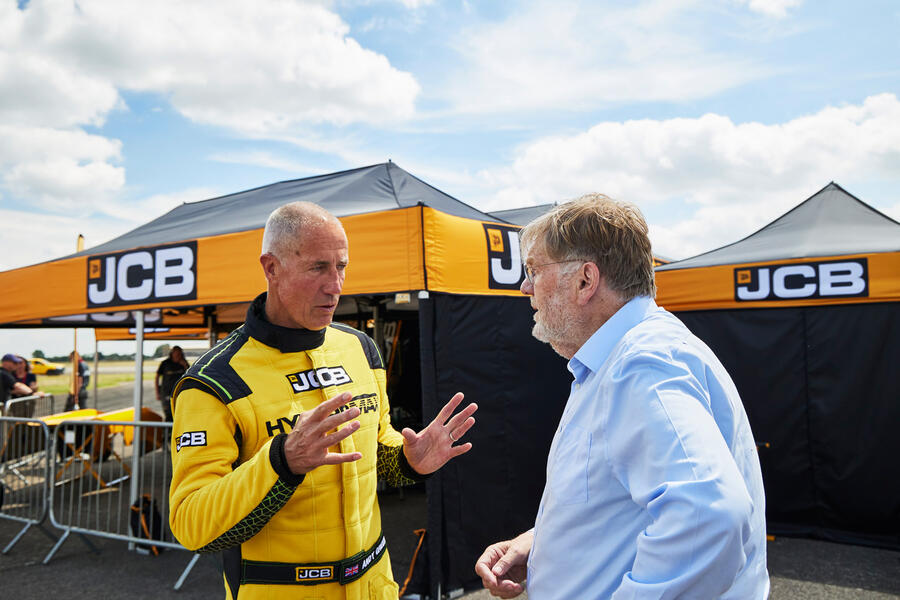
Steve Cropley visited the team during testing to find out how the project is developing.
Inside JCB’s UK test programme
For a week and a half the weather at RAF Wittering was hardly ever right, varying from driving rain to extremely gusty crosswinds; both entirely wrong for a long, narrow land speed record car urgently aiming to crack 200mph.
The JCB Hydromax team had set up a tent base for their all-British record breaker beside the pristine 1.7-mile main runway at Wittering, near Stamford, with the aim of getting as close to 200mph as possible before packing the car up and flying it to Wendover, Utah, nearest city to the Bonneville Salt Flats that are the home of world land speed record-breaking.Â
In the early days of August, a couple of weeks from now, the car is scheduled first to take part in the Southern California Timing Association’s time-honoured Bonneville Speed Week, its two turbocharged hydrogen digger engines each producing 600bhp, 200 below maximum.Â
Then in the second week, with the engines now making full power, Hydromax will tackle official FIA-sanctioned world records, on the way speeding past the 350mph mark set 20years ago by the slightly heavier, less sophisticated and 10% less aerodynamic JCB Dieselmax of 2006 which, while burning now-unfashionable diesel fuel, was similar in size and layout to Hydromax.
It’s of zero importance to history whether Hydromax beats Dieselmax; their different fuelling puts them in very distinct record categories. But there’s a big physical similarity between the pair — and JCB engineers make no secret that their Dieselmax experience was a major aid to the hydrogen project. Â
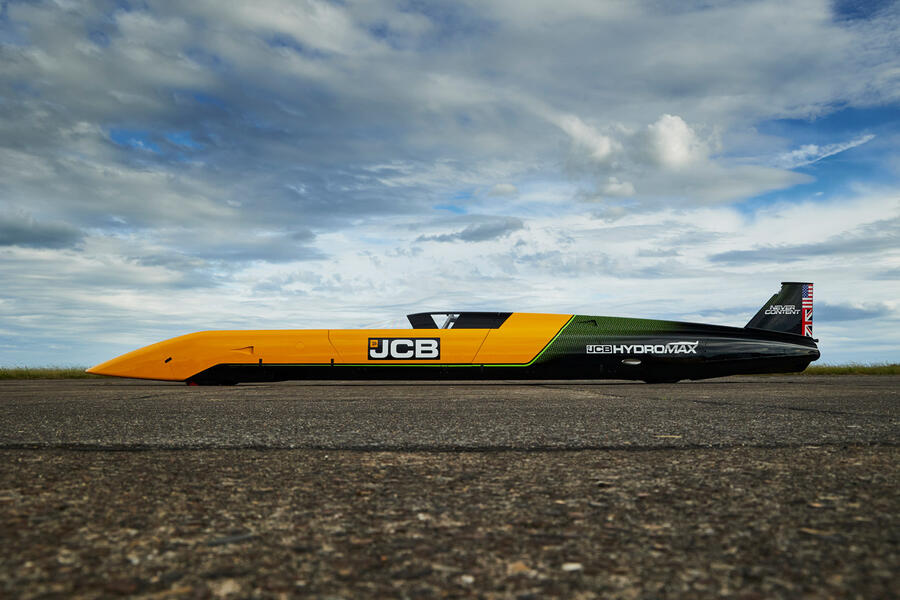
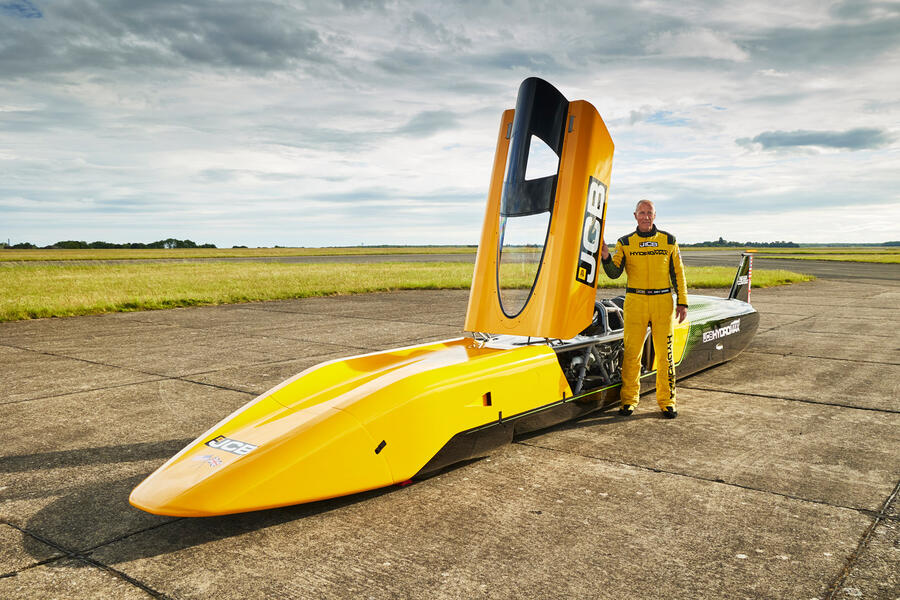
The cars are both very long, needle-nosed single-seaters — and both are built to contain the powerful physique of the redoubtable Wing Commander Andy Green, go-to land speed record driver of the past three decades and the world’s only man to have beaten the sound barrier on land (which he did at 763mph in 1997).Â
Apart from the tyre valves, Green wryly points out that he is the two cars’ only common component. His job is to beat the current record for hydrogen cars, set at 302.877mph in 2009 by a fuel cell streamliner, the Buckeye Bullet 2, designed by a team of Ohio University students and elevate it as far as possible. The current record for a hydrogen combustion car stands at an enticing 185.5mph, set by a BMW research prototype in 2004. With a bit of luck, they might have beaten this at Wittering.
JCB’s eye is particularly on pulverising this piston record; in fact they might have beaten it at Wittering. Fuel cells in vehicles are all very well, but after a five-year, £100million research programme that is about to bring hydrogen engines into diggers, its technical staff has reached the firm conclusion that hydrogen piston engines are by far the best option on compactness cost and durability grounds, among others.Â
The hydrogen units can be surprisingly similar in construction, affordability, component supply, power output and operator procedure to the 185,000 engines the company already makes annually.  Â
Hydromax and Dieselmax share the same wheelbase and are both four-wheel drive designs with each wheel-pair driven by its own much-modified version of JCB’s 4.8-litre four-pot digger engine. The two engines “talk†to one another electronically to deliver matched revs and power, and each drives its wheel pair through an XTrac six-speed transaxle (modified from racing applications). The whole thing weighs around 2.8 tonnes, a few percent lighter than its predecessor. Â
Aero requirements plus the need to accommodate the Hydromax’s bulky twin 700bar hydrogen tanks has required an increase in Hydromax’s 9.75-metre overall length by 560mm, while the cabin has been moved forward 450mm, also for packaging reasons.Â
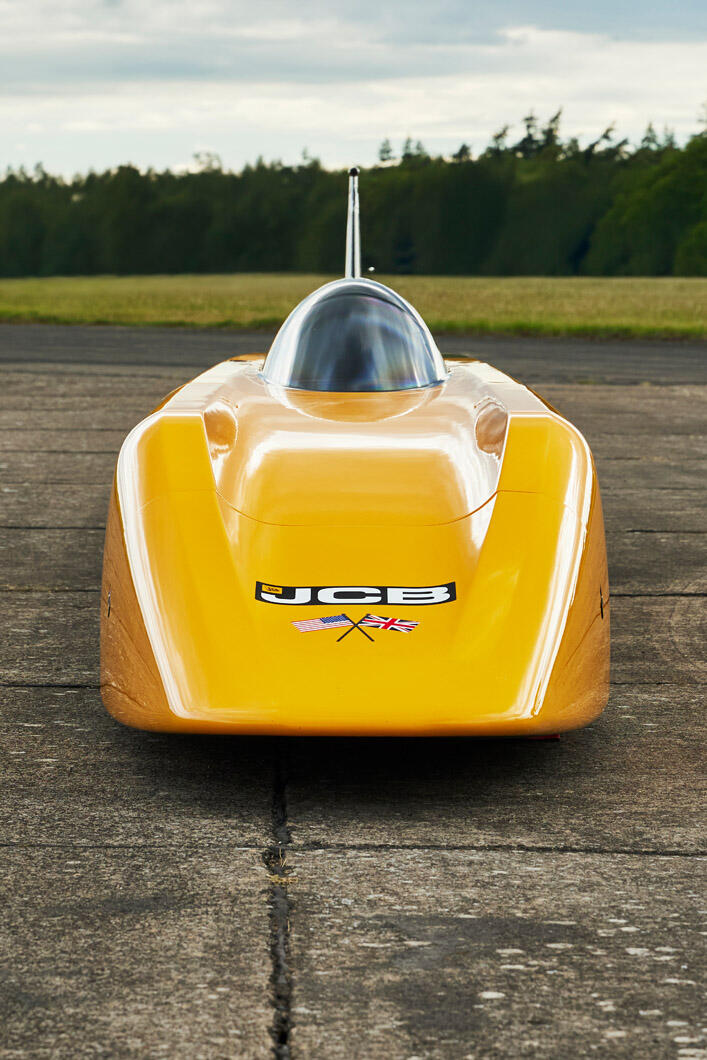
The massive tubular chassis and amazingly compact mult-link independent suspensions are the work of Prodrive, the Banbury race engineering group, who also designed and built Andy Green’s hugely strong carbon composite driver’s cell carried inside the chassis.
The tyres look similar to those from Dieselmax, but are new Goodyear units that as well as advancing the safe speed (JCB won’t say hope far) use more modern carcass construction and more sustainable materials, Engineers say that where Dieselmax was “limited on tyresâ€, Hydromax is not. Â
Hydromax’s CdA is 10% lower than its predecessor mostly through the assistance of CFD (computational fluid dynamics), a science that shapes and predicts airflow over cars much better than it could 20 years ago.Â
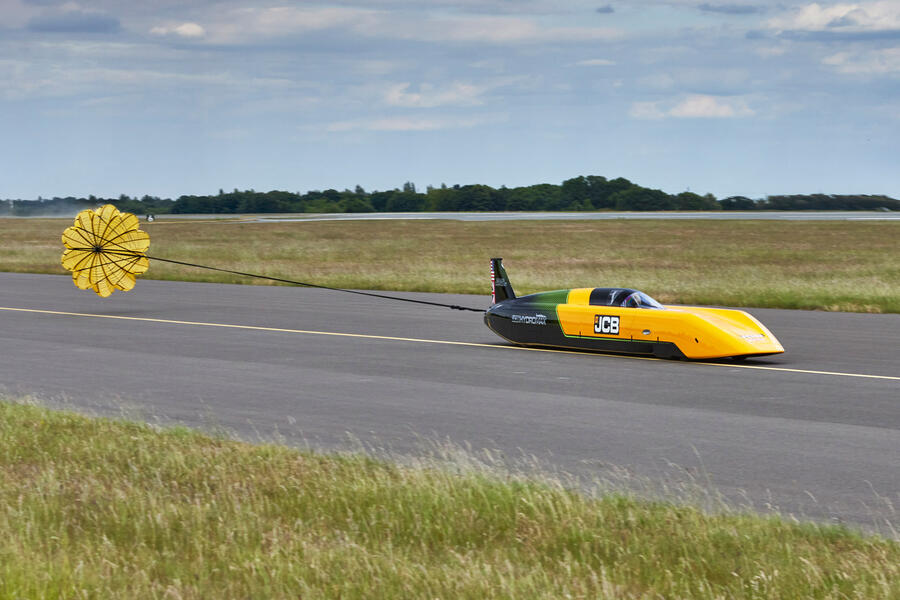
Among bigger tweaks, its results encouraged engineers to lengthen Hydromax’s tail for minimum departure turbulence, and to position its fin ideally for high speed stability. The rear extremity of the car is complex in design; it contains two parachutes (regular and reserve) for braking from high speed, and is reinforced sufficiently to allow it to be propelled to 40-50mph by a Defender Octa, after which it accelerated rapidly away in first gear.Â
Despite having to obey aerodynamic rules, Hydromax’s looks considerably more modern and sophisticated than its predecessor, mainly through the influence of JCB’s design director, Ben Watson, whose daunting day job is to make diggers look desirable. He gave Hydromax its “jet fighter†cockpit, lowered the nose, raised the body on its tyres (because they “grow†in circumference at high speed), refined the surfacing and ditched Dieselmax’s ugly snorkel airscoop in favour of a subtly-placed, low-drag NACA duct.
Nobody at JCB or Prodrive wants to talk top speeds, but given that the new car is lighter, more slippery and more powerful in its ultimate form, there’s good potential for Andy Green to exceed Dieselmax’s 20-year old mark of 350mph in the new car.
But success, everyone points out, can be as much down to weather and surface, as man and machine. The track, usually about 11 miles long, has been as short as five miles. The surface itself can vary in consistency, too, and past Bonneville Speed Weeks have been cancelled due to flooding. Small wonder the crew at RAF Wittering were frustrated by difficult weather…
Experiencing the Dieselmax at speed
When we arrived, they’d already been on site for a week and a half, with a few days to go. We heard a lot about JCB’s rationale for preferring hydrogen piston engines to fuel cells (the central rationale for building the car) and had plenty of chances to study the car’s graceful shape, and to see its wonders under the skin Engineers were having trouble with two things: the fit of a new set of panels that carried a new livery to dramatise our photographs, and a problem with the bleeding of the all-important cooling system that depends on a replenished ice supply rather than airflow.
But finally, around 3pm, we spectators were invited into a pedestrian corral halfway down the big runway to see the car go. This was to be Run No14, we were told, but the earlier ones hadn’t been energetic like this. They were just to get the wheels turning.
The pushing Octa (the team name for it is evidently Octa-pushy) got the car fairly slowly up to speed, then the engine fired, a deep bass bellow — or farther, two of them — and the action began. The long Hydromax, tiny but highly visible because of its new livery, shot off the front of the Defender and began to bolt for the horizon.
Without ceremony, with barely any impression of the violence of performance, it rushed past and away towards the horizon. There was no need to batter walls of air aside; it just cleaved it like an arrow. We kept needing to refocus, because it kept going faster until out of sight. The crew, some apprehensive and some a bit morose, suddenly perked up.Â
Then came news that Andy Green had managed to snap into third gear and accelerate, not possible before. As a result, he’d scored 177mph, not far short of the practical limit on this track, even with two parachutes and four large motorsport-spec discs to calm your forward motion. Two-point-eight tonnes creates plenty of inertia at 177mph.
Having proven it can beat the hydrogen piston mark the project now moves to Utah to do so at an officially sanctioned venue. Can this JCB-Prodrive alliance again prove the strength of British engineering? We’ll know soon.