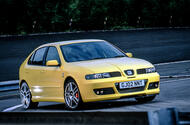
Sharp dynamics, a 221bhp punch and all from £5000 – the Leon Cupra R is a certifiable bargain
AMK. Or BAM. These are critical characters you must search for while grubbing about beneath the bonnet of any first-generation Seat Leon Cupra R on your buying horizon.
They’re part of the engine’s identification code, found on its offside front, the first trio of letters denoting the 207bhp 1.8 20-valve motor of 2002, or the 221bhp version that arrived a year later. If you can see these letters, then the Leon you’re looking at is almost certainly a genuine Cupra R rather than a sportily dressed version of a lesser model.
Such has been the passion for these cars that this fakery is possible. More than 4000 were sold in Britain between 2002 and 2006, the bulk of them with the more powerful engine. That’s a lot of hot Seats, especially as the Spanish brand was still attempting to cement itself a permanent place in the market and within VW’s portfolio.Â
That mission was certainly helped by the Cupra R, which arrived shortly before Seat went through a weird period in which it announced that it would be Spain’s budget answer to Alfa Romeo, before unleashing a series of MPVs of varying degrees of undesirability. But that’s another tale.
The Cupra R made a happier story, this pertly attractive hatch also doing well because at the time Volkswagen had forgotten how to make a GTI out of the Golf. Despite pretty much inventing the breed of which the Cupra was a member, VW made a mess of the fourth-generation GTI, this stodgy, slow and blandly unsatisfying iteration unworthy of its legendary suffix.Â
Not only was the Cupra R better styled, toned and girded for the job, but it was also much cheaper than the VW despite sharing the parts platform. It was also very fast - its 221bhp good for 6.9sec sprints to 60mph and a 159mph top speed. That was a lot of sub-£20k hot hatch thrust back in 2003, Seat boosting the Cupra R’s output in an effort to chase down Alfa Romeo’s then-new 147 GTA, which flung out 250bhp.Â
Signalling its ambitions for high-speed fly-swatting were a pleasingly modest body kit, big Brembo brakes, bigger wheels, a six-speed ’box, a steering wheel stitched with a racer’s location marker, white instrument faces and front seats embroidered with ‘R’ logos. All of which said ‘fast’ without yelling it. At the time the LCR, as the Leon Cupra R became known among fans keen to converse as swiftly as they traveled, was the most powerful production Seat yet. It also had a chassis that could handle it, mostly.Â
The Spaniards bestowed Wolfsburg’s suspension with more grip, better body control, swifter steering and, despite a flash set of 18in rims, a mostly pliant ride. Although you wouldn’t think that if a Leon wheel struck a deep, sharp-rimmed pothole, this strike likely to send a jarring impact through the seat and dashboard.
Dodge the holes, though, and you could drive like you were late for a date, everywhere. It was pretty good fun too, the aura of urgency heightened by the 20-valve’s 2200rpm torque peak tugging at the steering wheel rim like a sweet-seeking child. The only spoiler was this Seat’s slightly deadened feedback and an unwillingness to allow you much steering with the throttle. But it was better than plenty in its class, not least its pricier cousin, and that was enough to win it plenty of admirers.Â
Many of whom still feel the same way today - as the price of low mileage, unmolested (plenty have been ‘improved’), well-cared for cars can go past the £10,000 mark.