Swindon Powertrain has completely re-engineered a Lexus block to conquer Australia's fiercest racing series
A new mega-V8Â is tearing up Australia's Repco Supercars Championship, with the engine developed in the UK by Swindon Powertrain.
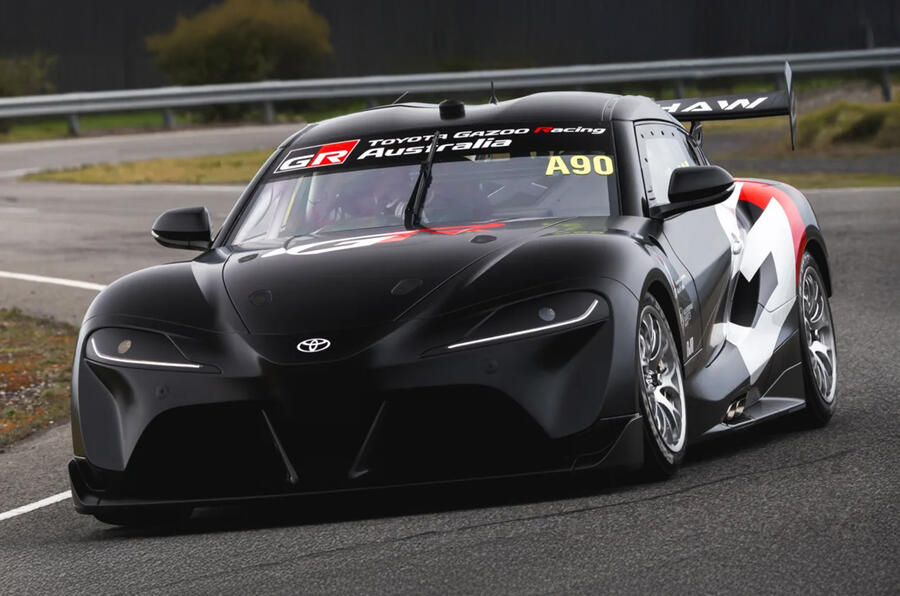
Swindon was appointed by Toyota's homologation partner, Walkinshaw TWG Racing, fielding two Gen3 Toyota GR Supras on behalf of Toyota Gazoo Racing Australia.
The 4969cc base unit is a substantially re-engineered Toyota 2UR-GSE V8, which first appeared in 2007 and has been used mainly in Lexus models.
The series' rules allow displacements of 5.0 and 5.7 litres, so Swindon Powertrain opted to increase the stroke from 89.5mm to 94mm by making a new crankshaft so the stroke matched the bore, to achieve the classic 'square' configuration. This meant the team met the rules without modifying the robust 2UR-GSE block.
The induction system has been changed, too. Direct injection isn't allowed in this series, so a conversion to port injection was necessary. The injector bores in the cylinder head were 'deleted', and now a new Swindon-designed and Walkinshaw TWG-manufactured inlet system accepts port injectors and the 'control' throttle body shared by all competitors.
The switch from direct to port injection means combustion characteristics change, so the combustion chambers were reworked to reflect that. Other mods to the V8's heads were kept to a minimum, aided by the fact that the standard port geometry suited high-performance applications.
The new induction manifold ensures perfect distribution of intake air across all cylinders, and acoustic characteristics match the engine's torque curve. The 3D-printed inlet tract is a technology proven on Swindon's BTCC-winning engines - it's made entirely of plastic 3D-printed and machined components.
Swindon designed new camshaft profiles using in-house valvetrain simulation software: they are in effect race cams designed to work within the limitations of the Toyota production valve rockers.
The 2UR-GSE production engine has hydraulic variable valve timing (VVT) for the exhaust cams and an electric VVT system for the inlets. All competitors must use a sealed 'control' engine ECU with supplied software; these don't support electronic VVT, so Swindon designed a new hydraulic system echoing that of the exhaust valvetrain. The work included new cam caps, cam covers and oilways.
Despite the modifications and new parts, most of the production engine's key components are retained, reflecting not only the regulations but also cost considerations. Swindon designs the new components, but the V8s are built and maintained at Walkinshaw TWG Racing's base near Melbourne.

